Chain Reaction
A chain reaction occurs when small change causes a similar but still different change nearby. This in logarithmic sequence like a curve.
EP‑Calculation, understood as a relational method, has the capacity to describe both familiar and previously unexamined phenomena when they are expressed as a sequence of interlinked ratios. In this form the phenomenon emerges as something akin to an exponential curve, each step containing the imprint of the previous one and extending naturally forwards and backwards along the line of progression.
The conceptual foundation of EP‑Calculation lies in the interplay of light and shadow — much in the same way that Plato perceived reality in his own time. The method echoes the Platonic cave allegory, in which shadows reveal truths that direct light conceals. The old saying “what one leaves behind, one will eventually meet again” captures the principle precisely: the shadow retains information that reappears when interpreted correctly.

The phenomenon grows like a product curve
Time dilation is, in certain respects, analogous to the development of a photographic image. It defines a pair of opposing effects: one manifests as the slowing of time, the other as an increase in mass. The distinction between the photographic process and the physical phenomenon lies in the role of time itself. In photography, each frame receives an individually chosen exposure time to achieve the optimal result. In physical phenomena, the optimal outcome arises from a fixed, light‑speed‑based time‑dilation coefficient of 1.0328.
Just as a photograph reveals different details depending on its exposure, time dilation reveals different aspects of motion and energy depending on the invariant ratio imposed by the speed of light. EP‑Calculation interprets this ratio in the same way a darkroom technician interprets exposure: as a controlled transformation that brings hidden structure into view.
Time slows down - mass increase
mass can touch - time can not touch
Light and shades
Line and lineless
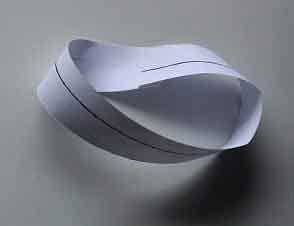
Cut a strip of paper and draw a continuous line along one of its sides. Twist the strip by 180 degrees and glue the ends together. The result is a loop that resembles the figure eight. The line now travels seamlessly across what used to be both sides of the paper, as though they formed a single continuous surface.
This simple construction illustrates the same principle on which EP‑Calculation is based: two sides that appear opposite or separate are, in reality, parts of one uninterrupted structure. When the perspective is rotated in the right way, the “other side” of a phenomenon is revealed not as something distinct, but as a natural continuation of the first.

26.5.2026*10:20 (1087 - 850)
www.karikolehmainen.com
epcalculation@gmail.com |
