Fourth Dimensionality of Bending
A bent beam has three tangible dimensions (width - height - length) and one intangible dimension (time).
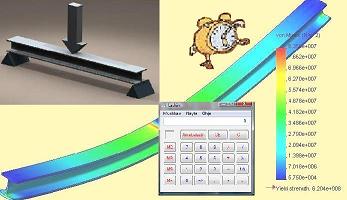
Dimensionality is defined as the minimum number of independent coordinates required to specify the position of points within a given space.
As an illustrative case, consider the fourth dimension—time—in a structural context. A timber support member is subjected to its nominal design load. After a year, the member exhibits additional deflection not only due to the sustained load and its self‑weight, but also due to time‑dependent deformation, i.e., creep. The three spatial dimensions are self‑evident, yet in timber the progressive, time‑driven increase in deflection may be interpreted as a manifestation of the structure’s behaviour in the fourth dimension.
Steel members also deflect under their self‑weight, as predicted by classical beam theory. However, provided the stress level remains well below the material’s allowable limit and the temperature is moderate, time‑dependent deformation in steel is negligible. In practical engineering applications, the influence of the temporal dimension on steel structures can therefore be disregarded, even though the underlying physical mechanism exists.
In fatigue phenomena, the governing parameters are the stress range and the number of load cycles. Calendar time itself is not the controlling variable. Time enters the problem only indirectly—for example through loading frequency, environmental exposure, or corrosion‑fatigue interactions—rather than as a primary determinant of fatigue life.

28.5.2026*9:05 (997 - 395)
www.karikolehmainen.com
epcalculation@gmail.com |
