Johannes Kepler
Ellipses Description of Planetary Orbits
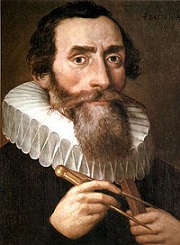 In the time, the Sun, Moon and planets were assumed to have a perfect circular orbits. Kepler rejected the idea of circular planetary orbits, and ended up the idea of their elliptical paths, as known nowadays. In the time, the Sun, Moon and planets were assumed to have a perfect circular orbits. Kepler rejected the idea of circular planetary orbits, and ended up the idea of their elliptical paths, as known nowadays.
Kepler discovered basing the calculations of planetary orbits to be elliptical. The minor axis ratio to longer axis in our solar system is 99 - 100%. A small "epicycle" of planetary orbits would be so small. The location of the sun is an ellipse focal point, and that is located at the other end of the orbit. This attention was not required to accept at first.
Johannes Kepler 
Freely translated
Your ellipses leads to the loss of roundness and smoothness of movements, which it seems to me foolish, I wonder what the deeper it. - If only you could keep perfectly circular orbit, and to explain the elliptical orbit with a small second episycle, the situation would be much better. - Astronomy David Fabricius
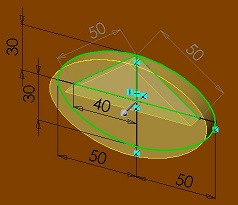
The Image belongs to the calculation
The planetary orbits are elliptical in shape. The minor axis ratio to longer axis in our solar system is 99 - 100%. A small "epicycle" of planetary orbits is so small. The location of the sun is an ellipse focal point, and that is located at the other end of the orbit. One description of the calculation is the light bulb, a mathematical sun on the earth. Still the calculating is description of the matter and physiology, not astronomy.
It is possible to draw an ellipse by several ways, having any understanding of it. You can ask almost anyone the importance of an ellipse, without the answer. The same when is asked drawing an ellipse with a pencil.

15.12.2014*10:15 (484 - 917)
www.karikolehmainen.com
epcalculation@gmail.com |
