Runnig a Race on the Track
Throughout history, people have raced each other. In the arenas of antiquity, the winner was decided in the simplest possible way: the runner who crossed the finish line first defeated the one behind. Relative position was enough — it was the only measure the world needed.
Accurate, comparable timing is a much younger invention. Only in the last few decades have we been able to measure a race to the hundredth of a second. Before that, there was no calculated time — only relation: ahead and behind, faster and slower.
The same pattern appears in natural phenomena. At first, everything seems straight and simple, like a running track stretching forward in a photograph. But as the phenomenon unfolds, the straight line begins to curve, shift and reveal its true form. Nature does not draw with a ruler; it draws with motion.
That is why the logic of a race can be linked to other natural processes. The Fibonacci sequence behaves like the rhythm of running distances: you begin by defining the shortest distance — 100 metres — as a single unit. From there, each step grows in a pattern that echoes through nature itself: in the spiral of a shell, the branching of a tree, the swirl of a galaxy.
A race is more than a contest. It is a small window into how nature builds relationships, measures differences and shapes the curves that make the world intelligible.
Sitting in the stadium grandstand finds the running lanes.
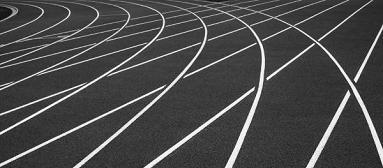
The 100‑ and 200‑metre sprints run along a straight track, but the 400‑metre race follows an oval. You accept this without a second thought: you couldn’t follow a 400‑metre race if it disappeared as a single endless line into the horizon. The track curves because the phenomenon needs a shape we can perceive.
Nature works the same way. At first, its formulas seem to progress in a straight, predictable line — like the lanes in a photograph of a running track. But as the phenomenon deepens, the straight line bends. It shifts, arcs and reveals a truer geometry. Nature does not move with a ruler; it draws its own oval.
1 - 1 - 2 -
100 m + 100 m + 200 m

10.5.2026*11:20 (907 - 612)
www.karikolehmainen.com
epcalculation@gmail.com
|
