Steel Plate Weight
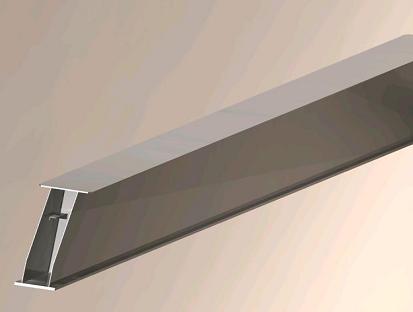
Commercial‑grade plate thickness corresponds directly to the calculated requirement. The geometry of the plate varies, as shown in the examples of a tank end and a crane main girder. What the designer needs is the theoretical plate form from which the working drawings and technical solutions are produced. The designer works with defined material specifications that determine both quality and thickness.
A physicist asks for the specific weight of a steel plate and illustrates the matter by drawing a circle with a compass. He assigns the circle a diameter of one (1). The plate thickness is likewise set to one (1). On this basis, the specific weight of steel is obtained as 0.785. You may choose the units yourselves, as they are irrelevant in a proportionality calculation.
3,14.. x 12 x 1 = 0.785
4
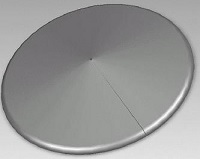 Information on plate thickness and material grade is transferred to the parts list of the drawing. Through proportionality, the value is carried over to the manufactured component and ultimately to the finished product. The values remain comparable with those of another product performing an equivalent function but of different size. We shall calculate this later. The illustrated products are plate components used in demanding structures. Information on plate thickness and material grade is transferred to the parts list of the drawing. Through proportionality, the value is carried over to the manufactured component and ultimately to the finished product. The values remain comparable with those of another product performing an equivalent function but of different size. We shall calculate this later. The illustrated products are plate components used in demanding structures.
 Thickness of the plates Thickness of the plates
Plate thickness can be calculated, which removes the need to memorise it. This was the first matter I examined, and it was from this that I came to understand proportionality between things.
0.6 - 0.8 - 1 - 1.2 - 1.5 - 2 - 2.5 - 3 - 4 - 5 - 6 - 8 - 10 - 12 - 15/16 - 20 - 25
0.63 - 0.8 -1 - 1.2 - 1.6 - 2 - 2.5 - 3.15 - 4 - 5 - 6 - 8 - 10 - 12 - 16 - 20 - 25
1.25 x 0.8 = 1 1.25 x 16 = 20
Steel mills produce plates in increments of 1.25. The weight of a steel plate is a three‑dimensional quantity, with thickness, width and length as its variables.
As a Thumb Rule
One square meter of 1 mm steel plate = 8 kg
Steel plates are manufactured with a positive thickness tolerance. Starting from the specific weight of steel, 7.85 kg/m³, the tolerance leads to a proportional value of 7.85 × 1.03 = 8.0. This is the common method for determining the weight of a steel plate. The weight varies according to surface area and plate thickness. When the surface area remains constant but the thickness changes, the factor 1.25 is raised to the power indicated by the step increase. The proportionality within steel plate behaviour is clearly observable. This type of calculation is what I practised in order to understand proportionality.
1. 2. 3. 4. 5. 6. 7.
1 - 1.25 - 1.6 - 2.0 - 2.5 - 3.15 - 4 - 5 - 6.3 -8.0 - 10
Example 1: Plate PL 5 3150 x 2500 mm => 8 kg/m2 x 3.15 m x 2.5 m x 5 = 315 kg
1.255 = 3.15 m 1,254 = 2,5 m
8 kg x 5 (1.255 x 1.03) x (1.254 x 1.03)= 316 kg
8 kg x 5 x 1.259 x 1.032 = 316 kg ( exact weight )
1,257 = 5 (plate thickness)
8 kg x 1.257 x 1.03 x 1.259 x 1.032 = 311 kg
8 x 1.2516 x 1.033 = 311 kg (differs 1,6 % )
Now the question; what is the factor 1.03?



14.4.2020*10:00 (878 - 545)
www.karikolehmainen.com
epcalculation@gmail.com |
