Leonardo da Vinci´s the Last Supper paintingLeonardo da Vinci, as a Renaissance polymath, possessed creativity and vision that extended beyond the boundaries of art, science, and engineering. Best known for works like Mona Lisa and The Last Supper, his sketches and notes also include elements related to clothing and fashion.
His anatomical drawings demonstrate a precise understanding of the human body, aiding in clothing design for fit and mobility. His sketches of mechanisms and technical inventions provide inspiration for modern clothing design—such as complex knots, layering, or garments that move with the wearer.
Leonardo also designed theatrical costumes and sets, showcasing his ability to combine aesthetics and practicality. His imagination and keen observational skills made him unique, and he would undoubtedly have been an innovative fashion designer had he delved into the field.
Behind Leonardo da Vinci's paintings lies another story, one that the Catholic Church did not allow him to tell us. He conveyed what he wanted to share through his works while also delivering what the patrons who funded them expected. Even today, the most learned continue to share this with us, though they are well aware of another truth.
Virgin of the Rocks (c. 1483–1486) Paris, Louvre The painting depicts an apocryphal moment from Jesus' childhood, in which John the Baptist meets Jesus' family on the road to Egypt, recognizing the child Jesus as the Christ. Oil on wood panel (transferred to canvas) 199 cm / 122 cm = 1.63
Oil on wood panel 189.5 cm / 120 cm = 1.579 1
1 1
1 2 1
(1.22 +1.20) m / 2 = 1.21
2 x 1.579 = 3.16 = π
4 x 1.57 = 6.28 radians = 2π radians
A quarter of a right angle, 6.28 radians, is 1.57, which is the principle by which antiquity calculated geometry and physical phenomena. EP Calculation based on radians and the speed of light finds its explanation when I elaborate on it. The dimensions of the Virgin of the Rocks painting are related to the Great Pyramid of Egypt, whose ratio of base width to height is…
230.34 m / 146.58 m = 1.57(1)
SQR (1.8952 + 1.202) = 5 Leonardo da Vinci was spiritually distant from the church. One example of this was when he dissected corpses he stole from the morgue to learn about human anatomy. His first observation was related to the five fingers and later the many meanings associated with them. In many senses, things are different from what we see. When we look at ourselves in the mirror, we see the left side of ourselves reflected as the right side and vice versa. The Roman Church needed the services of skilled individuals expressed as art, and artists needed the financial security offered by the Roman Church. Thus, both were mirror images of each other in an artistic sense. Future generations have largely refrained from explaining this feature, for many reasons that I won't delve into here. Through EP Calculations, however, we can observe a certain truth behind art, without addressing the brush technique and its development.
1 Jesus + 12 disciples = 1.12 as ancient mathematics coefficient
1 - 1.12 - 1.25 - 1.6 - 2.0
Looking at a painting does not require imagination to perceive it as a mirror image in terms of the setting and the number of people. The mirror writing used by Leonardo da Vinci refers to his method of writing text from right to left, so that it could only be read directly when viewed in a mirror. This means the letters are in reverse order—similar to how regular writing appears when reflected in a mirror. Some believe that Leonardo used mirror writing to protect his thoughts and observations from prying eyes. As Leonardo was left-handed, this writing style could have helped him avoid smudging the ink while writing.
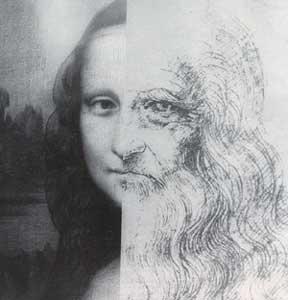
A woman's head position and breasts, mirrored to a masculine man
This is not directly taken from the painting, but it is an interpretation presented of the work.
Woman Mona Lisa - Man da Vinci
One interpretation is that the triangle between Jesus and Mary Magdalene represents the Holy Grail. According to the Gospel of Matthew. Matthew 26:28. It is part of Jesus' words during the Last Supper, where he says, "This is my blood of the covenant, which is poured out for many for the forgiveness of sins" In Christian mythology, the Holy Grail is a vessel in which Joseph of Arimathea collected blood from the wounds of the crucified Jesus. In the evening, the stomachs of those crucified were pierced so that they would die. For those crucified, this was merciful, and the inhabitants could sleep through the night without hearing cries of agony.
The composition in the painting related to the numbers three and four consists of four groups of three people. The numbers illustrate the geometry of a quarter, meaning a quadrant of a circle in mathematics, as well as the sacred number three. This can also be visualized in our minds as three perceivable dimensions. Leonardo da Vinci presents things in his paintings in a reversed manner, which required intelligence and knowledge of the structure of the world. What is seen and known is different and opposite.
Our modern era defines a full angle as 360 degrees. In past antiquity, as presented by da Vinci, angles were expressed in radians, which even today can present a conceptual challenge for those educated in contemporary schools. Despite this, we also calculate certain things in gradians to obtain results. In this definition, 90 degrees equals 1.57 radians. 6.28 radians / 4 = 1.57 radians
Leonardo da Vinci was not religious, and why would he have been, as an intelligent person? He was aware of the activities of the monastic orders of his time as well as the atrocities committed by the Vatican, neither of which could withstand scrutiny in many respects. We all understand that a boat will capsize if everyone is on the same side. This very composition of the painting illustrates that idea. Additionally, communication would not have been possible if everyone were sitting on the same side of the table.  4,60 m x 8,80 m
4,60 m / 8,80 m = 0,523
8,80 m / 4,60 m = 1,913
(4,60 / 8,8) x (8,8 / 4,60) = 1
( , = .)
The Royal Ancient Cubit Measure 0,523 m 1 x 8 + 1 = 9 The smallest unit of mathematics in antiquity was one, just as in our modern mathematics. Leonardo conveyed this in his painting. Leonardo da Vinci was too intelligent compared to any contemporary art expert. None of the artists of our time can match him, but he was not allowed to reveal the reality of antiquity. Who among us has dissected a body just to draw the structure of the human organism? EP Calculations reveal the hidden truth of antiquity through the mathematics of that time. 1 1 1 / 0.523502332 = 987654369
The largest sphere by volume is 0.5235023 times the volume of the cube.
You are unlikely to find a table set with clear glass in the history of painting as a depiction of the beginning of our era. In this context, Leonardo da Vinci painted an inaccurate representation of the time, just as he created a parallel depiction to the commonly known portrayal of the event in his painting. Additionally, throughout history, glass has been a luxury reserved only for the wealthy, and even then, it was often colored. Jesus' disciples were poor fishermen and similar laborers, so glasses as shown in the painting would have been unlikely. The production of clear glass is associated with the introduction of manganese dioxide in Alexandria. This likely occurred several decades after the beginning of our era.
Leonardo da Vinci's The Last Supper is full of symbolism, and even the tableware has sparked curiosity. Interestingly, Jesus himself does not appear to have a cup, which has led to various theories about its significance. This is one of the incorrect interpretations, as Jesus does indeed have a drinking glass in front of him, which anyone can observe in the painting if they wish. Furthermore, the drinking vessel is not a cup, but a clear drinking glass from a later period. 1 + 12 = 1.12
Mona Lisa 0,77 m x 0.53 m 3D view of the world x 0,53 = 1,59 (mistake 0,02 radians, later seen in his painting)
Our modern era defines a full angle as 360 degrees. In past antiquity, as presented by da Vinci, angles were expressed in radians, which even today can present a conceptual challenge for those educated in contemporary schools. Despite this, we also calculate certain things in gradians to obtain results. In this definition, 90 degrees equals 1.57 radians.
Ancient Egyptian royal Cubit 1 x 8 + 1 = 9 SQRT (0,774- 0,534) = 0,522
|